A guide to subfloor repair
In short
- Most Florida homes have a concrete slab subfloor; upstairs floors usually sit on plywood.
- Every floor has a flatness and moisture limit set by its manufacturer.
- Grinding, levelling, crack repair and plywood replacement bring the subfloor within those limits.
Concrete slab or plywood
A concrete slab is poured on the ground and is the base for most single-storey homes in Central Florida. Plywood or OSB sheets on joists form the subfloor upstairs, in raised floors and in many older homes.
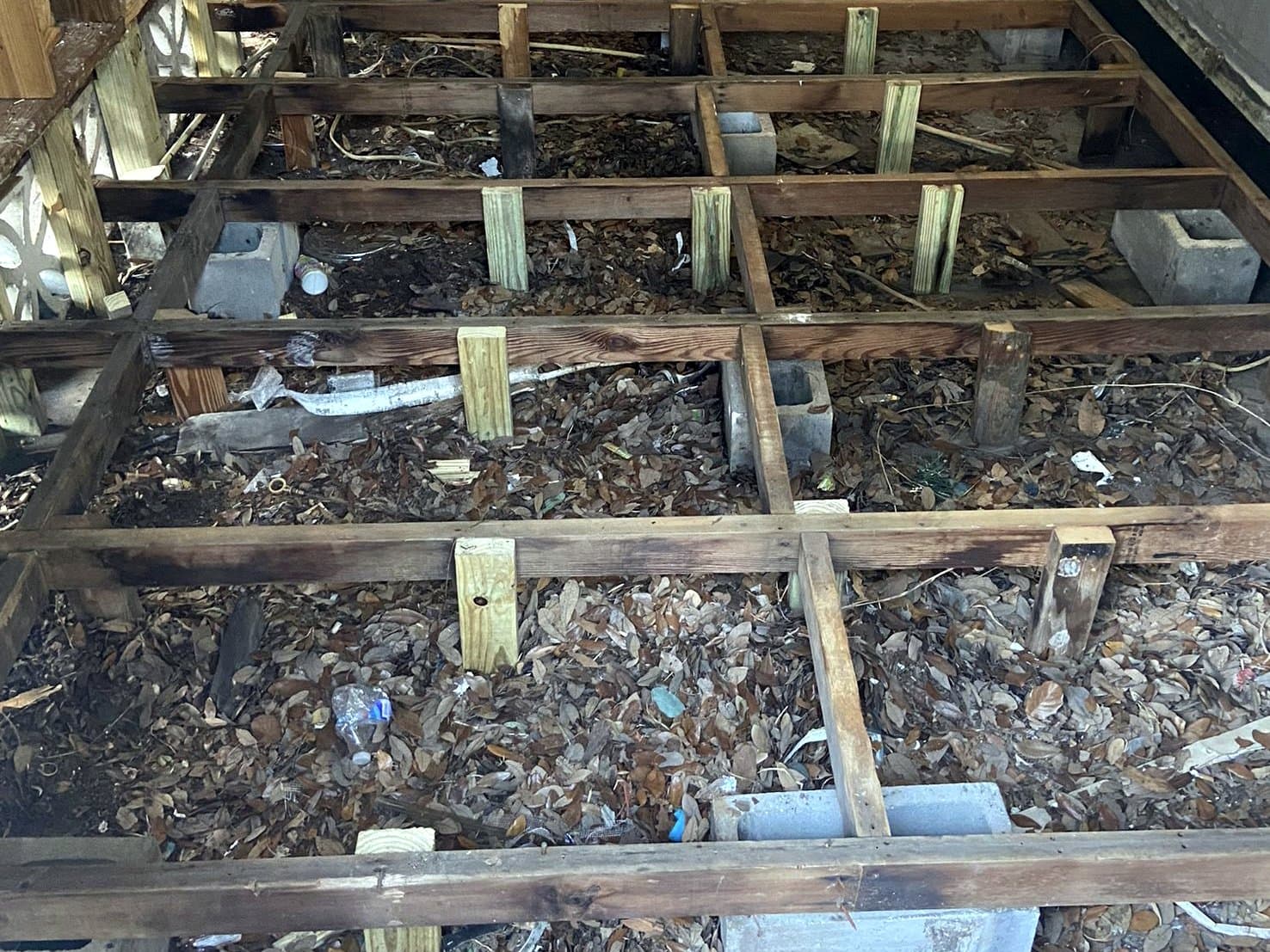
Slabs are strong but can be uneven, cracked or damp. Plywood can sag, squeak, delaminate or rot after a leak.
How flat does a subfloor need to be?
Flooring manufacturers set a flatness limit, usually measured as the largest gap under a straightedge over a given length. Many vinyl plank products call for no more than about 3/16 inch over 10 feet. Tile standards commonly call for 1/4 inch over 10 feet, and tighter, about 1/8 inch over 10 feet, for large-format tile.
Always follow the requirement for the exact product being installed; it is printed in the installation instructions.
| Floor | Typical flatness requirement |
|---|---|
| Vinyl plank (click-lock) | About 3/16 in over 10 ft |
| Ceramic and porcelain tile | About 1/4 in over 10 ft |
| Large-format tile (an edge 15 in or longer) | About 1/8 in over 10 ft |
| Hardwood | Per manufacturer; often similar to vinyl plank |
How is subfloor moisture tested?
Concrete slabs release moisture, and too much can break down adhesives, cause mould under floors and swell wood. Common tests measure moisture emission at the surface or relative humidity inside the slab.
If the slab is too damp for the chosen floor, the options include a moisture-mitigation coating, a different adhesive or a floating floor with a vapour barrier.
How is a concrete slab repaired?
- Grinding high spots and ridges flat.
- Filling low spots with a patching or self-levelling compound.
- Cleaning out and filling cracks, with a crack-isolation membrane under tile.
- Removing old adhesive, paint and coatings.
- Priming before levelling compounds so they bond.
How is a plywood subfloor repaired?
- Screwing loose sheets down to the joists to stop squeaks and movement.
- Cutting out and replacing soft, delaminated or water-damaged sections.
- Adding a new underlayment layer where the surface is rough.
- Fixing the leak or moisture source first, so the repair lasts.
What are the signs of a subfloor problem?
- Soft, springy or sagging spots.
- Gaps opening between vinyl planks.
- Cracked or hollow-sounding tiles.
- Squeaks when you walk.
- Visible dips, humps or ridges under the floor.
What affects the cost of subfloor repair?
- How far the subfloor is from the required flatness.
- Area to grind or level, and how much compound is needed.
- Number and width of cracks.
- Amount of damaged plywood to replace.
- Removing the old floor and adhesive first.
- Moisture mitigation, if the slab needs it.
What should you ask a subfloor repair contractor?
- How will you measure flatness and moisture?
- Which flatness requirement applies to my new floor?
- Is subfloor preparation listed separately on the estimate?
- What caused the problem, and does the repair fix the cause?