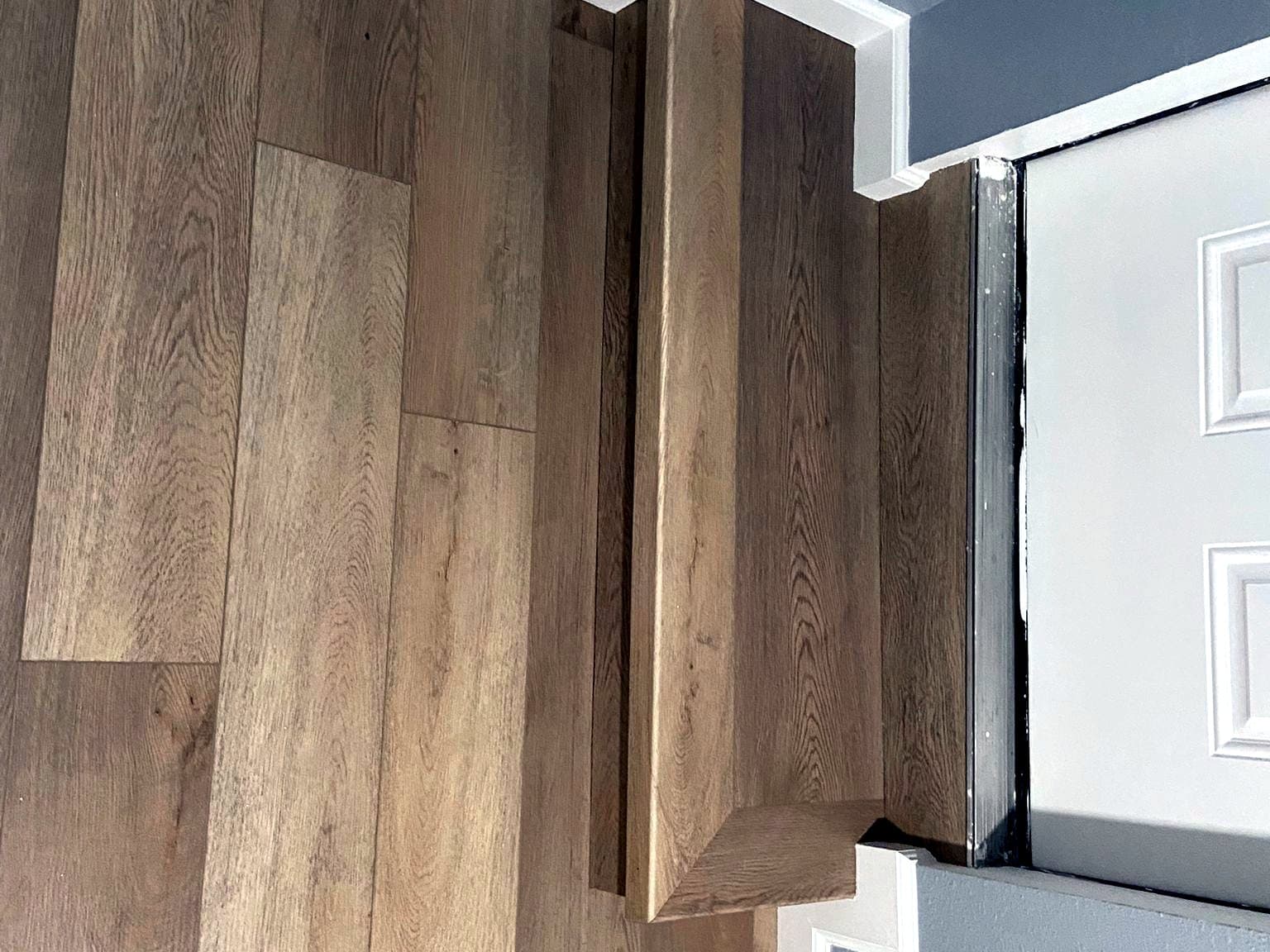
A guide to stair flooring
In short
- Stairs can be finished in vinyl plank, hardwood, tile or carpet to match your floors.
- Every hard-floor step needs a firmly fixed nosing on its front edge.
- Stairs are usually priced per step, plus landings and trims.
Which flooring works best on stairs?
| Option | Look and feel | Notes |
|---|---|---|
| Vinyl plank | Matches plank floors; waterproof | Fitted with matching stair nosing |
| Hardwood | Classic, warm | Treads and risers in real wood |
| Tile | Durable, cool underfoot | Best on concrete stairs |
| Carpet | Soft, quiet, warm | Needs a firm stair pad |
What is stair nosing?
The nosing is the front edge of each step. It takes the most wear and matters most for safety. With vinyl plank and hardwood, a matching nosing piece covers and protects the edge.
Can carpeted stairs be changed to hard flooring?
Carpet is removed, the stairs are checked and prepared, then treads, risers and nosing are fitted to each step. Landings are finished to match.
Safety on stairs
- Choose a textured surface rather than a high-gloss one.
- Make sure every nosing is firmly fixed.
- Keep stair lighting good, especially at the top and bottom.
The parts of a staircase
Knowing the names helps you compare quotes.
| Part | What it is |
|---|---|
| Tread | The part you step on |
| Riser | The vertical face between treads |
| Nosing | The front edge of the tread |
| Landing | The flat area between flights or at the top |
| Stringer | The side boards that support the steps |
Matching stairs to your floors
Stairs look best when they match the floors they connect. With vinyl plank and hardwood, treads and nosing are cut from or made to match the same product. With tile, the same tile can wrap the tread and riser, finished with a trim on the edge.
Some homeowners choose a contrast instead, such as dark treads with painted white risers. Either way, decide before the floors go in so the materials can be ordered together.
What mistakes should you avoid on stairs?
- Loose or poorly fixed nosing, which is a trip hazard.
- High-gloss finishes that are slippery underfoot.
- Treads that do not match the floor colour at the top and bottom.
- Carpet on stairs without a firm stair pad.
What affects the cost of stair flooring?
- The number of steps and landings.
- The floor type and matching nosing.
- Removing the old carpet, tile or treads.
- Open sides or curved steps, which need more cutting.
What should you ask a stair flooring installer?
- Will you check the slab or subfloor before you price the job?
- Is floor preparation listed separately on the estimate?
- Are removal, trims, transitions and baseboards included?
- Will you confirm the material is in stock before I pay a deposit?
- Which manufacturer installation requirements apply, and will you follow them?
- Is stair nosing included for every step?
- How are landings priced?
Carpet or hard flooring on stairs?
Carpet is quieter and softer, and gives more grip for small children and pets. Hard flooring is easier to clean, looks sharper and matches hard floors downstairs.
A common compromise is hard treads with a stair runner: the look of wood or vinyl with a softer, quieter path down the middle.
How is stair flooring installed?
- Old carpet, tack strip and staples are removed, or old treads taken off.
- Each step is checked, repaired where needed and cleaned.
- Risers are fitted first, then treads, working from the bottom up.
- Matching nosing is fixed to the front edge of each tread.
- Landings are finished to match and trims fitted at the top and bottom.
Stair safety basics
New flooring should not change the height of individual steps unevenly, because steps of different heights are a trip hazard. When hard flooring is added over existing stairs, the top and bottom steps need particular attention so every step stays the same height.
Choosing materials for busy stairs
Stairs take concentrated wear on the front edge of each step. For busy family homes, choose a hard-wearing product: a vinyl plank with a thicker wear layer, a hardwood with a durable factory finish, porcelain tile, or a dense carpet made for stairs.
Matching the stairs to the rest of the floor usually looks best, but the stair product itself must be rated for stair use.
Stair runners
A runner is a strip of carpet fitted down the middle of hard treads. It softens footsteps, adds grip and protects the treads, while the wood or vinyl still shows at the sides.
Runners are fixed at every step, so they stay put. Choose a flat, dense weave that does not overhang the nosing.
Lighting and visibility
A small colour contrast between the tread and the nosing, or between treads and risers, helps people see where each step ends. Good lighting at the top and bottom of the stairs matters just as much, especially for children and older family members.
How do you care for stair flooring?
- Vacuum or sweep stairs often; grit wears the nosing first.
- Check nosing and treads for movement and have loose pieces fixed straight away.
- Clean hard stairs with the product the manufacturer recommends; avoid anything that leaves them slippery.